Παρασκευή 21 Οκτωβρίου 2011

William Russell Flint ''The Idyls of Theocritus 1922''

Theocritus Idyl II
She too came, the sweetly smiling Cypris, craftily smiling she came, yet keeping her heavy anger


Theocritus Idyl VI
To hear this makes her jealous of me,by Paean, and she wastes with pain,and springs madly from the sea


Theocritus Idyl X
The Reapers They all call thee a 'gipsy,' gracious Bombyca, and 'lean,' and 'sunburnt,''tis only I that call     thee 'honey-pale'


Theocritus Idyl XIII
Hylas and Heracles The nymphs all clung to his hand, for love of the Argive lad had fluttered the soft hearts of all of them


Theocritus Idyl XIV
She caught up her robes, and forth she rushed, quicker than she came


 Theocritus Idyl XVI
 Hiero, like the mighty men of old, girds himself for fight, and the horse-hair crest is shadowing his helmet


Theocritus Idyl XVIII
Then sang they all in harmony, beating time with woven paces, and the house rang round with the ridal song
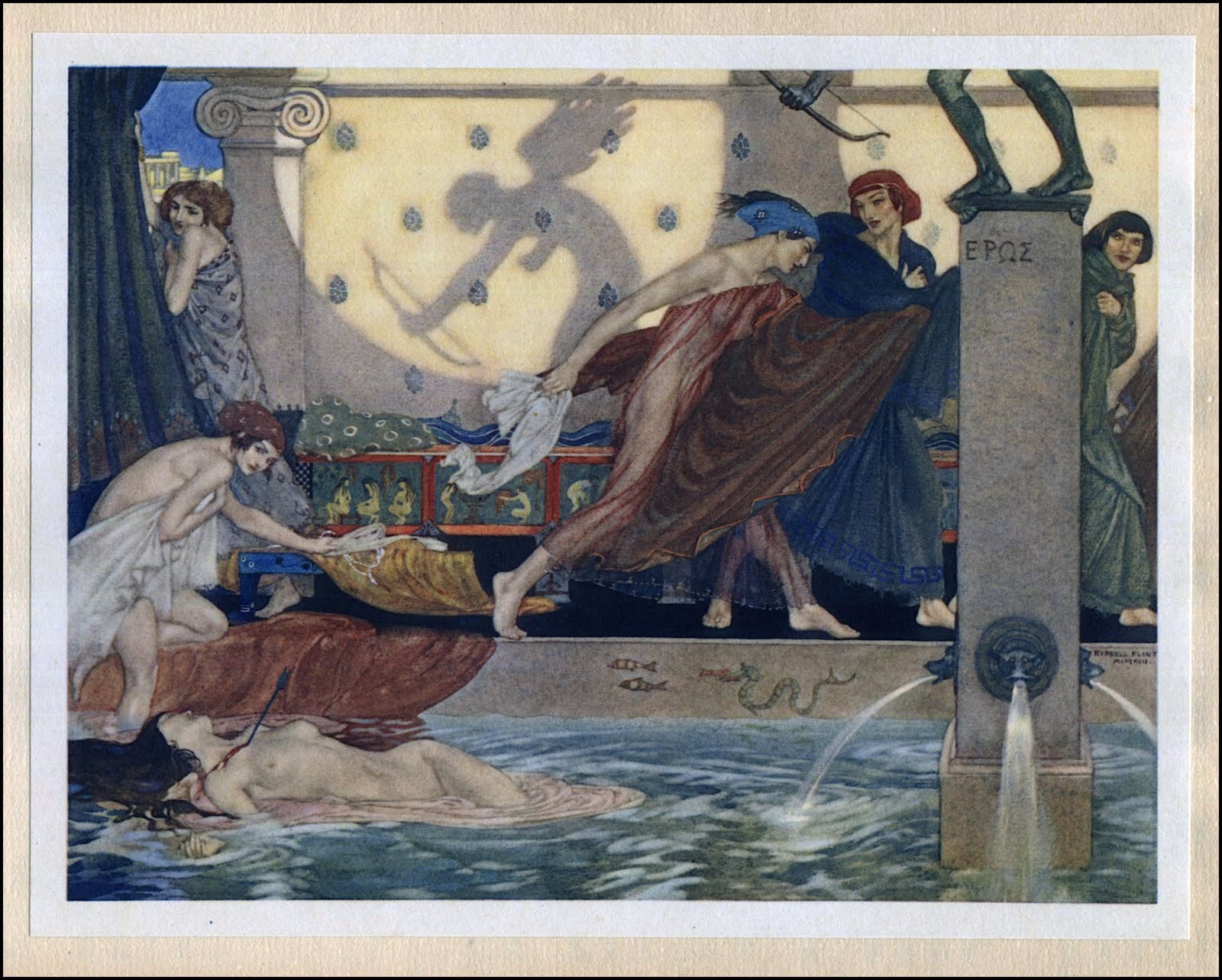

Theocritus Idyl XXIII
The Vengeance of Love Love stood on a pedestal of stone above the waters. And lo, that statue leapt and killed that cruel one


Theocritus Idyl XXVI
'Tis for thee to caress thy kine, not a maiden unwed

"Theocritus, Bion and Moschus" (1922) Illustrated by William Russell Flint

"Theocritus, Bion and Moschus" (1922), as published across two volumes by The Medici Society Limited (London), includes an adaptation of works attributed to the Greek Bucolic poets that had been translated by Andrew Lang from the texts of Wordsworth (in the case of Theocritus) and Ziegler (in respect of Bion and Moschus).
A brief description of the lives of the poets is provided through references to ancient sources - those appear below.

Life of Theocritus (from "Suidas")
Theocritus, the Chian. But there is another Theocritus, the son of Praxagoras and Phillina or as some say of Simichus. He was a Syricusan, or, as others say, a Coan settled in Syracuse.He wrote the so-called "Bucolics" in the Dorian dialect. Some attribute to him the following works:- "The Proetidae", "The Pleasure of Hope", "Hymns", "The Heroines", "Dirges","Ditties", "Elegies", "Iambics", "Epigrams". Be it known that there are three Bucolic poets: this Theocritus, Moschus of Sicily, and Bion of Smyrna, from a village called Phlossa.

Life of Theocritus (usually prefixed to the "Idyls")
Theocritus the Bucolic poet was a Syracusan by extraction, and the son of Simichidas, as he says himself, "Simichidas, pray whither through the noon dost thou drag thy feet?" ("Idyl VII").Some say that this was an assumed name, for he seems to have been snub-nosed and that his father was Praxagoras, and his mother Philinna. He became the pupil of Philetas and Asclepiades, of whom he speaks ("Idyl VII"), and flourished about the time of Ptolemy Lagus.He gained much fame for his skill in bucolic poetry. According to some, his original name was Moschus, and Theocritus was a name later assumed.

Bion
Bion was born in Smyrna, one of the towns which claimed the honour of being Homer's birthplace. If we could believe a possible apocryphal verse of the dirge by Moschus, it might be thought that Theocritus survived Bion. The same dirge tells us that Bion was poisoned by certain enemies, and that while he left to others his wealth, to Moschus he left his minstrelsy.

Moschus
Our only certain information about Moschus is contained in his own Dirge for Bion. He speaks of his verse as ''Ausonian Song', and of himself as Bion's pupil and successor.It is plain that he was acquainted with the poems of Theocritus.

William Russell Flint's suite of illustrations published in "Theocritus, Bion and Moschus" (1922)  included 20 colour images presented as tipped-in plates. Prepared prior to World War I, the effects of The Great War caused a delay of nearly a decade to the publication.
That same suite was also published one year earlier by Artur Wolf Verlag (Wien) in a German language Limited Edition in ''Idyllen des Klassischen Altertums'' based upon a translation prepared by Ernst Roenau. Interestingly, the Artur Wolf Verlag variant carried no monotone illustration by Russell Flint on the Title Page, but rather, a monotone illustration depicting Cherion and Jason as a solo preliminary design - that illustration being the same that had appeared on the Title Page for the 1912 First Edition of ''The Heroes; or, Greek Fairy Tales for My Children''. ''Idyllen des Klassischen Altertums'' (1921) is one of the rare examples among vintage illustrated books where the initial publication of a suite from an English-speaking artist has occurred in another language the year prior to the English language First Edition.

About William Russell Flint
Sir William Russell Flint (4 April 1880 – 30 December 1969) was a Scottish artist and illustrator who was known especially for his watercolour paintings of women. He also worked in oils, tempera, and printmaking.
He was born in Edinburgh. From 1894–1900 Flint apprenticed as a lithographic draughtsman while taking classes at the Royal Academy of Art, Edinburgh. From 1900–02 he worked as a medical illustrator in London while studying part-time at Heatherley's Art School.[2] He furthered his art education by studying independently at the British Museum. He was an artist for the Illustrated London News from 1903–07, and produced illustrations for editions of several books, including Chaucer's The Canterbury Tales (1912).
Flint was president of Britain’s Royal Society of Painters in Watercolours (now the Royal Watercolour Society) from 1936 to 1956, and knighted in 1947.
During visits to Spain he was impressed by Spanish dancers, and he depicted them frequently throughout his career.[2] Flint enjoyed considerable commercial success but little respect from art critics, who were disturbed by a perceived crassness in his eroticized treatment of the female figure.
William Russell Flint was active as an artist until his death in London on 30 December 1969.

http://shop.sirwilliamrussellflint.co.uk/
http://www.bpib.com/flint.htm
http://en.wikipedia.org/wiki/William_Russell_Flint
http://largesizepaintings.blogspot.com
http://spiritoftheages.com/

Πέμπτη 20 Οκτωβρίου 2011

Mozart - Complete Masonic Music (Istvan Kertesz) Decca


Mozart - Complete Masonic Music!
Werner Krenn, Tom Krause,Gerog Fischer (Piano / Organ Accompanist)
The Edinburgh Festival Chorus (Arthur Oldham : Chorus Master )
Istvan Kertesz Conducting The London Symphony Orchestra
Label : Decca, 1969 London Release!

Buy : http://www.classicalvinyl.com/vinyl-records/sxl-6409-complete-masonic-music-mozart.html
Info's : http://en.wikipedia.org/wiki/Mozart_and_Freemasonry

Mozart's lodges :
Mozart was admitted as an apprentice to the Viennese Masonic lodge called "Zur Wohltätigkeit" ("Beneficence") on 14 December 1784.[1] He was promoted to journeyman Mason on 7 January 1785, and became a master Mason "shortly thereafter".Mozart also attended the meetings of another lodge, called "Zur wahren Eintracht" ("True Concord"). According to Otto Erich Deutsch, this lodge was "the largest and most aristocratic in Vienna. ... Mozart, as the best of the musical 'Brothers,' was welcome in all the lodges." It was headed by the naturalist Ignaz von Born.
Mozart's own lodge "Zur Wohltätigkeit" was consolidated with two others in December of 1785, under the Imperial reform of Masonry (the Freimaurerpatent, "Masonic Decree") of 11 December 1785, and thus Mozart came to belong to the lodge called "Zur Neugekrönten Hoffnung" (New Crowned Hope).
At least as far as surviving Masonic documents can tell us, Mozart was well regarded by his fellow Masons. Many of his friends were Masons.
During his visit to Vienna in 1785, Mozart's father Leopold also became a Mason.

Masonic ideology and Masonic music :
Mozart's position within the Masonic movement, according to Maynard Solomon, lay with the rationalist, Enlightenment-inspired membership, as opposed to those members oriented toward mysticism and the occult. This rationalist faction is identified by Katherine Thomson as the Illuminati, a masonically inspired group which was founded by Bavarian professor of canon law Adam Weishaupt, who was also a friend of Mozart. The Illuminati espoused the Enlightenment-inspired, humanist views proposed by the French philosophers Jean-Jacques Rousseau and Denis Diderot. For example,the Illuminati contended that social rank was not coincident with nobility of the spirit, but that people of lowly class could be noble in spirit just as nobly born could be mean-spirited. This view appears in Mozart's operas; for example, in The Marriage of Figaro, an opera based on a play by Pierre Beaumarchais (another Freemason), the lowly-born Figaro is the hero and the Count Almaviva is the boor. However, Masonic scholars themselves,and non-Masonic scholars who have studied the matter more closely strongly dispute both the conflation of Freemasonry with Illuminati elements perse, and especially Mozart as Mason in relation to these elements.
The Freemasons used music in their ceremonies, and adopted Rousseau's humanist views on the meaning of music. "The purpose of music in the {Masonic} ceremonies is to spread good thoughts and unity among the members" so that they may be "united in the idea of innocence and joy," wrote L.F. Lenz in a contemporary edition of Masonic songs. Music should "inculcate feelings of humanity, wisdom and patience, virtue and honesty, loyalty to friends, and finally an understanding of freedom."
These views suggest a musical style quite unlike the style of the Galant, which was dominant at the time. Galant style music was typically melodic with harmonic accompaniment, rather than polyphonic; and the melodic line was often richly ornamented with trills, runs and other virtuosic effects. The style promoted by the Masonic view was much less virtuosic and unornamented. Mozart's style of composition is often referred to as "humanist" and is in accord with this Masonic view of music.
The music of the Freemasons contained musical phrases and forms that held specific semiotic meanings. For example, the Masonic initiation ceremony began with the candidate knocking three times at the door to ask admittance. This is expressed musically as a dotted figure:

List of Mozart's Masonic compositions :

The following is a list of surviving works that Mozart composed for performance at gatherings of Masons.

Lied (song) "Gesellenreise," K. 468, "for use at installation of new journeymen", March 1785
Cantata for tenor and male chorus Die Maurerfreude ("The Mason's Joy"), K. 471, premiered 24 April 1785
The Masonic Funeral Music (Maurerische Trauermusik), K. 477/479a, no later than November 1785.
Two songs, K. 483 and K. 484, to celebrate the opening of "Zur Neugekrönten Hoffnung"; 14 January 1786.
Cantata for tenor and piano, Die ihr die unermesslichen Weltalls Schöpfer ehrt, K. 619 (1791)
The Little Masonic Cantata (Kleine Freimaurer-Kantate) entitled Laut verkünde unsre Freude, for soloists, male chorus, and orchestra, K. 623, premiered under the composer's direction 18 November 1791.
The story and music of his opera The Magic Flute is also considered to have strong Masonic influences.
Mozart's grandfather Johann Georg, a bookbinder, was raised among the extended Mozart family in Augsburg, in the house of Johann's own grandfather David Mozart. David and his children were distinguished architects and master operative (craft) masons of the Augsburg guild (as contrasted to speculative freemasons).[15] But close affinities among operative and speculative existed in this period.

References :
Braunbehrens, Volkmar (1990) Mozart in Vienna. New York: Grove and Weidenfeld.
Deutsch, Otto Erich (1965) Mozart: A Documentary Biography. Stanford: Stanford University Press.
Solomon, Maynard (1995) Mozart: A Life. Harper Collins.
Thomson, Katherine (1977) The Masonic Thread in Mozart. London: Lawrence and Wishart. ISBN 853153817


Τρίτη 18 Οκτωβρίου 2011

Cave of Forgotten Dreams (2010) On line


Cave of Forgotten Dreams (2010) http://www.caveofforgottendreams.co.uk/ In 1994, a group of scientists discovered a cave in Southern France perfectly preserved for over 20,000 years and containing the earliest known human paintings. Knowing the cultural significance that the Chauvet Cave holds, the French government immediately cut-off all access to it, save a few archaeologists and paleontologists. But documentary filmmaker, Werner Herzog, has been given limited access, and now we get to go inside examining beautiful artwork created by our ancient ancestors around 32,000 years ago. He asks questions to various historians and scientists about what these humans would have been like and trying to build a bridge from the past to the present.


"IT'S ALMOST LIKE WATCHING THE REINVENTION OF THE CINEMATIC MEDIUM" 5 Stars THE GUARDIAN

“THERE ARE MANY MOMENTS HERE THAT QUICKEN THE PULSE. MANY THAT ARE REMARKABLE. AND A FEW THAT ARE ABSOLUTELY AWESOME" SUNDAY TIMES CULTURE - WALDERMAR JANUSCZAK

“HERZOG SUPERBLY CONVEYS (IN 3D) THE MYSTERY AND THE MAJESTY OF THESE PAINTINGS” 4 Stars THE INDEPENDENT

“A FASCINATING, IDIOSYNCRATIC FILM THAT DEMANDS TO BE SEEN IN 3D” 4 Stars DAILY EXPRESS

4 Stars FINANCIAL TIMES

“PROFOUND, MYSTERIOUS AND UTTERLY ABSORBING” 5 Stars EMPIRE

1 persons dies and million cry 1 million die and no one cries!


Every human being is equally important,we do related with all not only by flesh but from Spirit too.
Whatever the name can be given from us in all these different parts of this world, He is our Creator. 
I was surprised last week when i saw so many people saw grief for the death of Mr. Steve Jobs on the net,and today looking this poster i realize how much hypocrites we are.
I can ask...Technology made our life much fancier and easier, still are we? Did help us to be better persons?
1 persons dies and million cry 1 million die and no one cries!

Σάββατο 15 Οκτωβρίου 2011

Επτα ποιηματα - Γ.Ι.Π.


1. 

Ένα φιλί
που μεταμορφώνεται σε άστρο
όταν τα χείλη μου αγγίξουν τα δικά σου
εκεί χάνονται και τα όνειρα μου
για να γεννηθούνε άλλα όνειρα
είναι η αγάπη σου που με κρατάει στην ζωή

18 Μαΐου 2010

2. 

Η περιπλοκή και η σχηματοποίηση του λόγου σε εικόνες που γεννούν εύλογα συμπεράσματα
αποσκοπεί στην σύγχυση τον γνωστών ιδεών
διαβάλλοντας την κοινωνία μας και της μορφές της
διάγουμε ένα βίο ασύμβατο με το προαναφερθέν
ο πόλεμος είναι μια δοκιμή θανάτου
και η εξόντωση μας ο νόμος του κακού
συνοδοιπόροι ας μην αρκεστούμε στο ευτελές και άσχημο
ας οδηγηθούμε στην ευμορφία ενός νεοπλασματικού
αέρινου φαντάσματος,μιας και η αλήθεια υπερβαίνει το απρόσκοπτων.

3.
Μέσα στην σιωπή
Όπως η νύχτα ξεδιπλώνεται αργά.
Μια μορφή όπως θαμπά την φέρνει ο άνεμος κοντά μου
Σαν σχήμα αερικού να με διαπερνά σε μια στιγμή που όλα αναταράσσονται.

Στον πάνω και τον κάτω κόσμο σ' έψαχνα προαιώνια
μάρτυρας μου, τις καρδιάς μου οι πληγές
τα αδειανά μου χέρια
το χλομό μου βλέμμα

Όπως η νύχτα ξεδιπλώνεται αργά
ο Έρωτας έγινε παρόν
Το τέλος έγινε αρχή...

4.
Η δύναμη μου είναι η αγάπη που αναβλύζει από τα ματιά σου
η λύτρωση μου συνάμα
λίγο πριν τον μεγάλο αποχαιρετισμό
όταν ο χρόνος παύση να μιλά
και ο λόγος πάρει μορφή
το χέρι σου θα κρατώ γερά
μες στην αγκαλιά σου δεν φοβάμαι τα πελώρια κύματα
τι κιάν η γη σκίζεται στα δυο
το φως μέσα από τα μάτια σου θα μας οδήγηση τότε
βλέπεις εγώ δεν ζήτησα να ψηλαφίσω τα σημάδια από τα καρφιά
ποτέ η αμφιβολία δεν με άγγιξε
να που χανόμαστε μες την αγάπη σου.

5. 

Είναι η τέχνη που γεννά την τέχνη ή ο άνθρωπος?
ή και τα δυο?
Ένα όμως είναι το τρανό μυστήριο!
Ο άνθρωπος, το τέλος του και το τέλος της τέχνης του.

6.
Σε μια στιγμή αδυναμίας
αναπόλησα τις όμορφες στιγμές που πέρασαν
ανοίγω την καρδιά μου για τις καινούργιες,
όταν αυτές θα έρθουν.
Ένας μόνον άνθρωπος φαντάζει τόσο ασήμαντος,
σε έναν τόσο μεγάλο και άπειρο κόσμο!
Κανε την καρδιά σου φυλακή,
να παύση η πνοή μου
να χαθεί,
γιατί εκεί ανήκω. Πριν ακόμη γεννηθώ.

7.
Η διαρκής κίνηση
είναι προϊόν μετάβασης στον χρόνο και στον χώρο
η σημαντικότητα τις εξαρτάται από το κίνητρο τις απελευθέρωσης τις σκέψης και την μετατροπή τις σε πράξη.
Το αποτέλεσμα τις κίνησης λέγεται ζωή το αποτέλεσμα τις μη κίνησης λέγεται σοφία
όταν η δράση μετατρέπεται σε μη δράση παράγεται καθαρή ενέργεια
μέσο αυτής η μορφή γίνετε συμπαντική
τότε η απελευθέρωση από τον χώρο και το χρόνο έχει ολοκληρωθεί

Παρασκευή 14 Οκτωβρίου 2011

Το Νυχθημερόν του Απολλώνιου του Τυανέα


Το Νυχθημερόν του Απολλώνιου του Τυανέα

Ο Απολλώνιος, Τυανέας έζησε την ίδια εποχή με τον Ιησού της Ναζαρέτ. Και οι δυο είχαν το δικό τους, ιδιαίτερο καθήκον. Ενώ ο Ιησούς μιλούσε ως επί το πλείστον για τους εκλεκτούς του μέλλοντος, ο Απολλώνιος μιλούσε άμεσα σε εκείνους οι οποίοι συνειδητά αναζητούσαν την απελευθέρωση και ίδρυσαν μια Γνωστική Σχολή. Το Νυχθημερόν του αναφέρεται στην «Ημέρα του Θεού που λάμπει στο Σκοτάδι». Αυτή η Ημέρα διαιρείται σε δώδεκα ώρες, οι οποίες περιγράφονται με δώδεκα, σύντομους αφορισμούς και οι οποίοι με μια πρώτη ματιά δείχνουν εξαιρετικά δυσνόητοι και αινιγματική. Όταν ωστόσο ο Jan van Rijckenborgh εφαρμόζει το γνωστικό κλειδί (την εσωτερική κατανόηση ότι υπάρχει ένας εσωτερικός Θεός φυλακισμένος στο σκοτάδι του μικροκόσμου μας, ο οποίος πρέπει να αφεθεί ελεύθερος), αυτοί οι αφορισμοί αποκαλύπτουν μια σειρά από δώδεκα βήματα, τα οποία αν αναληφθούν, θα επιτρέψουν στην «Ημέρα του Θεού» να ανατείλει στη ζωή μας.


    Το Νυχθημερόν του Απολλώνιου του Τυανέα από τον Jan van Rijckenborgh  (Υπο έκδωση)

Πηγη :
Buy :
More :
Official site :

Free books for you from my collection :

1.
John Henry Newman (1801 1890) The life of Apollonius Tyanaeus (1826)

2a.
Philostratus, The Life of Apollonius of Tyana Volume I. Books 1 5
2b.
Philostratus, The Life of Apollonius of Tyana Volume II. Books 6 8. Epistles of Apollonius. Eusebius

3.
Thomas Whittaker (1856-1935) Apollonius of Tyana, and other essays (1906)