Εμφάνιση αναρτήσεων με ετικέτα Theocritus. Εμφάνιση όλων των αναρτήσεων

Παρασκευή 21 Οκτωβρίου 2011

Θεόκριτος (Ειδύλλια)


Ο Θεόκριτος ήταν ένας από τους σημαντικότερους ποιητές της Ελληνιστικής εποχής, πρωτοπόρος της βουκολικής ποίησης που άνθισε περίπου τον 3ο π.Χ αιώνα. Για τη ζωή του Θεόκριτου δεν διαθέτουμε πολλές πληροφορίες, ενώ όσα γνωρίζουμε προέρχονται κυρίως από το ίδιο το έργο του. Πιθανότερη χρονική περίοδος γέννησής του θεωρείται το 300 π.Χ. περίπου, καθώς η ακμή του συνέπεσε με την 124η Ολυμπιάδα (284 - 280 π.Χ.). Σχετικά με τον τόπο καταγωγής του, μία ευρύτερα αποδεκτή θεώρηση είναι πως γεννήθηκε στις Συρακούσες, άποψη που φαίνεται να επιβεβαιώνεται και μέσα από το ίδιο το έργο του (Ειδύλλιο XXVIII, στ. 16-18). Θεωρείται επίσης πολύ πιθανό πως έζησε στην Κω, την Αλεξάνδρεια καθώς και στην Αίγυπτο την περίοδο του Πτολεμαίου Β'.

Ο Θεόκριτος αναγνωρίζεται ως ένας από τους σημαντικούς ποιητές του αρχαίου κόσμου. Από το σύνολο του έργου του, διασώθηκαν τριάντα ποιήματα, που αργότερα συγκεντρώθηκαν κάτω από το γενικό τίτλο Ειδύλλια.

Ειδύλλια
Αμφιβολίες έχουν διατυπωθεί και ως προς τη γνησιότητα οκτώ ειδυλλίων και συγκεκριμένα για τα υπ'αριθμόν 8, 9, 19, 20, 21, 23, 26 και 27. Ο όρος ειδύλλια χρησιμοποιήθηκε πιθανόν λόγω της μικρής έκτασης των ποιημάτων, αντίθετα με τα έπη.Επύλλια δηλ. ειδύλλια (αγλ.Idyls) μοιάζουν με το έπος, γιατί αφηγούνται περιπέτειες ηρώων, αλλά είναι πολύ πιο σύντομα και πραγματεύονται το θέμα τους με φυσικότερο τρόπο και πιο άνετη διάθεση. Κυρίως ασχολούνται με το δωρικό ήρωα Ηρακλή (Ηρακλίσκος, Ύλας) και σ΄αυτά ανήκει και το μεγαλύτερο ποίημα του Θεοκρίτου, ο Ύμνος εις Διοσκούρους.

ΘΕΟΚΡΙΤΟΥ ΕΙΔΥΛΛΙΑ - XXVI. ΛΗΝΑΙ H ΒΑΚΧΑΙ
Μετάφραση Ι. Πολέμη

Αγαύη κι Αυτονόη κ' Ινώ, του Κάδμου οι θυγατέρες,
τρεις ήταν και τρεις έκαναν πομπές του Διονύσου
στον Κιθαιρώνα. Εσύναξαν εκείθεν άγρια φύλλα
πυκνόφυλλης βελανιδιάς, χλωροί κισσού κλωνάρια,
επήρανε στα χέρια τους και νιόβγαλτα σπερδούκλια
κ' έκαναν δώδεκα βωμούς σ' ολάνοιχτο λιβάδι,
εννιά για το Διόνυσο και τρεις για τη Σεμέλη.
Έβγαλαν τότε τα ιερά μέσ' από το κουτί των
και στους βωμούς τ' απίθωσαν μ' ευχές πολλές στο Βάκχο,
όπως αυτός επιθυμεί κι όπως τις είχε μάθει.

Ο δύστυχος Πενθεύς κρυφά, από τραχύ ένα βράχο,
πίσω από σκίνο γέρικο, εθώρει ό,τι γενόταν.

Πρώτη τον εκατάλαβεν η Αυτονόη, κι αμέσως
έρριξε φοβερή κραυγή και ξαφνικά πηδώντας
εγκρέμισε κ' εσκόρπισε τα σύμβολα του Βάκχου
πούν' άπρεπο να τα θωρούν οι αμάθευτοι οι ανθρώποι.
Τότε κ' εκείνη εμάνιωσε κ' εμάνιωσαν κ' οι άλλες.
Φεύγει ο Πενθεύς τρεχάμενος και κατατρομαγμένος,
κι αυτές, ανασηκώνοντας το φόρεμα ως τη ζώνη,
έτρεχαν κατά πίσω του και τον εκυνηγούσαν.
Κ' είπεν ο δύστυχος Πενθεύς: «τί θέλετε. γυναίκες;».
«Τώρα θα 'δης τί θέλομε» τούπεν η Αυτονόη.
Και σαν λιοντάρι που γεννά μουγκρύζοντας η Αγαύη
τούκοψε το κεφάλι του μητέρα του κι' ας ήταν,
και στην κοιλιά του ορμητικά η Ινώ ποδοπατώντας
του σύντριψε τον ώμο του μ' όλη την ωμοπλάτη·
τα ίδια κι απαράλλαχτα κ' η τρίτη η Αυτονόη·
κ' οι άλλες που τη βακχική πομπήν ακολουθούσαν
τ' απομεινάρια κρέατα μοίρασαν μεταξύ των,
κι όλες γεμάτες αίματα γυρίσανε στη Θήβα
φέρνοντας από το βουνό πένθος κι όχι Πενθέα.

Δε νοιάζομαι· μηδέ κανείς ας νοιάζεται για 'κείνον
που εχθρεύεται ο Διόνυσος, χειρότερα κι αν πάθη,
άντρας απ' τη γυναίκα του ή και παιδί απ' τη μάννα·
εγώ είμαι θρήσκος και ποθώ να ευχαριστώ τους θρήσκους.
Πάντοτ' ο θρήσκος άνθρωπος έχει τιμή απ' το Δία.
Του θρήσκου τα παιδιά ευτυχούν, κακοπαθούν του αθρήσκου.

Χαίρε, Διόνυσε, που ο Ζευς σ' έβγαλ' απ' το μερί του
και σ' έρριξε στο Δράκανο το χιονοσκεπασμένο·
χαίρε, Σεμέλη, χαίρετε και σεις οι αδερφές της
κόρες του Κάδμου ηρωικές που δίκαια τιμωρείτε·
αυτό που εσείς εκάνατε τώχε προστάξει ο Βάκχος.
Κανείς ας μην καταφρονή ό,τι οι θεοί προστάζουν.


Θεόκριτος - Αποφθέγματα

«Το κάλλος δεν είναι παρά μια τερπνή προκατάληψη.»

«Η καλλονή κατακτάει και προκαλεί την εύνοια εκείνων, που την κοιτάζουν.»

«Η ανάγκη είναι το κεντρί των καλών τεχνών. Αυτή μόνο παρακινεί τον άνθρωπο στη δουλειά.»

«Θάρρος, φίλε μου, μπορεί η αυριανή μέρα να σου είναι πιο ευνοϊκή. Όσο υπάρχει ζωή, υπάρχει και ελπίδα. Ο Δίας μας στέλνει πότε μια όμορφη ηλιόλουστη ημέρα και πότε μια άλλη με θύελλα και βροχή.»

«Πρέπει να έχετε θάρρος, γιατί το αύριο ίσως είναι καλύτερο.»

«Το κρασί λέγεται και αλήθεια.»

«Τυφλός ο έρως.»

«Πενία τέχνας κατεργάζεται.»

Info's :
http://www.mikrosapoplous.gr/theocritus/thcrts0.htm
http://el.wikipedia.org/wiki/Θεόκριτος
http://www.theoi.com/Text/TheocritusIdylls1.html
http://www.sansimera.gr/

Buy :
http://www.perizitito.gr/product.php?productid=42533
http://www.greekbooks.gr/theokritos.person
http://www.amazon.com/gp/product/0674990315

William Russell Flint ''The Idyls of Theocritus 1922''

Theocritus Idyl II
She too came, the sweetly smiling Cypris, craftily smiling she came, yet keeping her heavy anger


Theocritus Idyl VI
To hear this makes her jealous of me,by Paean, and she wastes with pain,and springs madly from the sea


Theocritus Idyl X
The Reapers They all call thee a 'gipsy,' gracious Bombyca, and 'lean,' and 'sunburnt,''tis only I that call     thee 'honey-pale'


Theocritus Idyl XIII
Hylas and Heracles The nymphs all clung to his hand, for love of the Argive lad had fluttered the soft hearts of all of them


Theocritus Idyl XIV
She caught up her robes, and forth she rushed, quicker than she came


 Theocritus Idyl XVI
 Hiero, like the mighty men of old, girds himself for fight, and the horse-hair crest is shadowing his helmet


Theocritus Idyl XVIII
Then sang they all in harmony, beating time with woven paces, and the house rang round with the ridal song


Theocritus Idyl XXIII
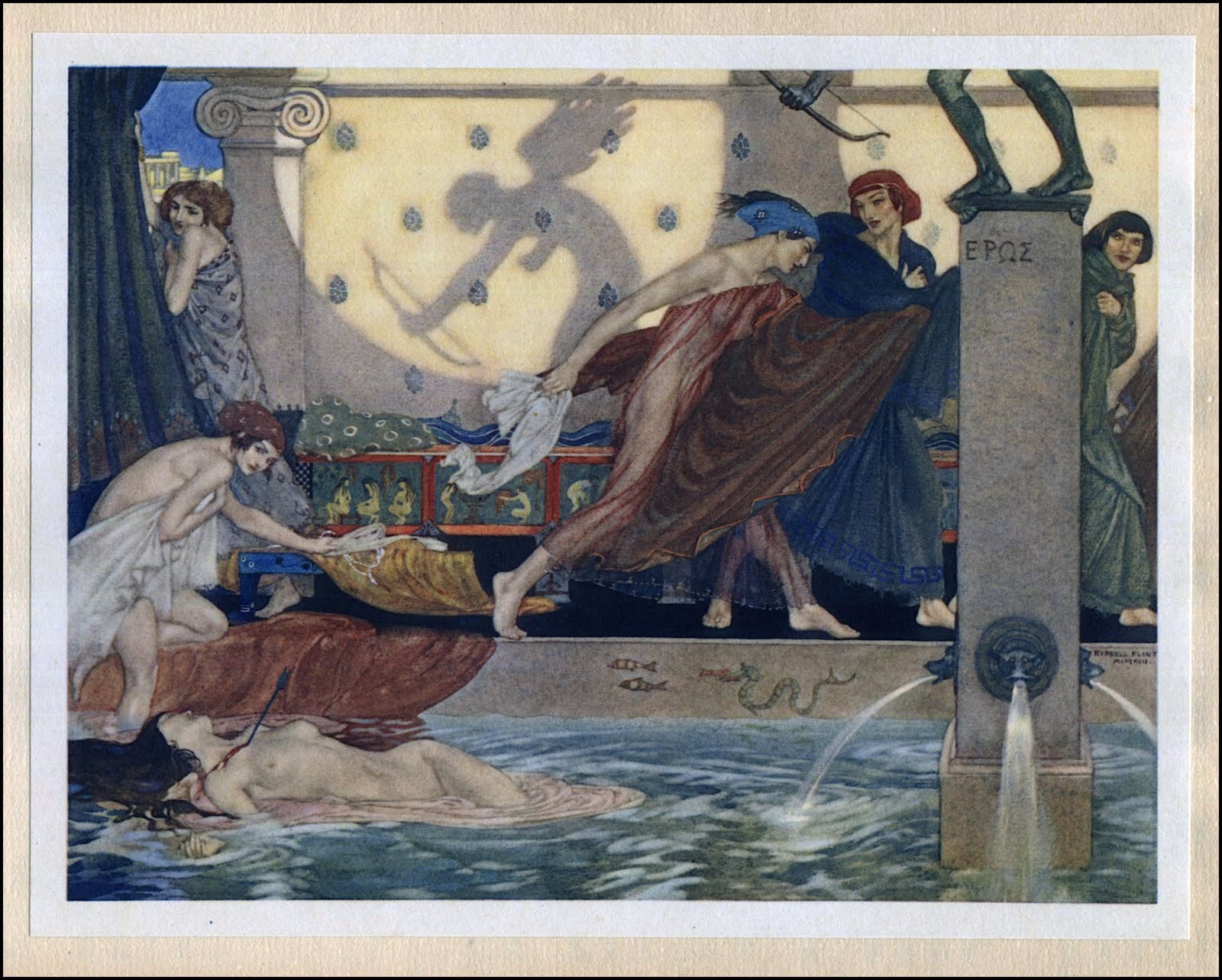
The Vengeance of Love Love stood on a pedestal of stone above the waters. And lo, that statue leapt and killed that cruel one


Theocritus Idyl XXVI
'Tis for thee to caress thy kine, not a maiden unwed

"Theocritus, Bion and Moschus" (1922) Illustrated by William Russell Flint

"Theocritus, Bion and Moschus" (1922), as published across two volumes by The Medici Society Limited (London), includes an adaptation of works attributed to the Greek Bucolic poets that had been translated by Andrew Lang from the texts of Wordsworth (in the case of Theocritus) and Ziegler (in respect of Bion and Moschus).
A brief description of the lives of the poets is provided through references to ancient sources - those appear below.

Life of Theocritus (from "Suidas")
Theocritus, the Chian. But there is another Theocritus, the son of Praxagoras and Phillina or as some say of Simichus. He was a Syricusan, or, as others say, a Coan settled in Syracuse.He wrote the so-called "Bucolics" in the Dorian dialect. Some attribute to him the following works:- "The Proetidae", "The Pleasure of Hope", "Hymns", "The Heroines", "Dirges","Ditties", "Elegies", "Iambics", "Epigrams". Be it known that there are three Bucolic poets: this Theocritus, Moschus of Sicily, and Bion of Smyrna, from a village called Phlossa.

Life of Theocritus (usually prefixed to the "Idyls")
Theocritus the Bucolic poet was a Syracusan by extraction, and the son of Simichidas, as he says himself, "Simichidas, pray whither through the noon dost thou drag thy feet?" ("Idyl VII").Some say that this was an assumed name, for he seems to have been snub-nosed and that his father was Praxagoras, and his mother Philinna. He became the pupil of Philetas and Asclepiades, of whom he speaks ("Idyl VII"), and flourished about the time of Ptolemy Lagus.He gained much fame for his skill in bucolic poetry. According to some, his original name was Moschus, and Theocritus was a name later assumed.

Bion
Bion was born in Smyrna, one of the towns which claimed the honour of being Homer's birthplace. If we could believe a possible apocryphal verse of the dirge by Moschus, it might be thought that Theocritus survived Bion. The same dirge tells us that Bion was poisoned by certain enemies, and that while he left to others his wealth, to Moschus he left his minstrelsy.

Moschus
Our only certain information about Moschus is contained in his own Dirge for Bion. He speaks of his verse as ''Ausonian Song', and of himself as Bion's pupil and successor.It is plain that he was acquainted with the poems of Theocritus.

William Russell Flint's suite of illustrations published in "Theocritus, Bion and Moschus" (1922)  included 20 colour images presented as tipped-in plates. Prepared prior to World War I, the effects of The Great War caused a delay of nearly a decade to the publication.
That same suite was also published one year earlier by Artur Wolf Verlag (Wien) in a German language Limited Edition in ''Idyllen des Klassischen Altertums'' based upon a translation prepared by Ernst Roenau. Interestingly, the Artur Wolf Verlag variant carried no monotone illustration by Russell Flint on the Title Page, but rather, a monotone illustration depicting Cherion and Jason as a solo preliminary design - that illustration being the same that had appeared on the Title Page for the 1912 First Edition of ''The Heroes; or, Greek Fairy Tales for My Children''. ''Idyllen des Klassischen Altertums'' (1921) is one of the rare examples among vintage illustrated books where the initial publication of a suite from an English-speaking artist has occurred in another language the year prior to the English language First Edition.

About William Russell Flint
Sir William Russell Flint (4 April 1880 – 30 December 1969) was a Scottish artist and illustrator who was known especially for his watercolour paintings of women. He also worked in oils, tempera, and printmaking.
He was born in Edinburgh. From 1894–1900 Flint apprenticed as a lithographic draughtsman while taking classes at the Royal Academy of Art, Edinburgh. From 1900–02 he worked as a medical illustrator in London while studying part-time at Heatherley's Art School.[2] He furthered his art education by studying independently at the British Museum. He was an artist for the Illustrated London News from 1903–07, and produced illustrations for editions of several books, including Chaucer's The Canterbury Tales (1912).
Flint was president of Britain’s Royal Society of Painters in Watercolours (now the Royal Watercolour Society) from 1936 to 1956, and knighted in 1947.
During visits to Spain he was impressed by Spanish dancers, and he depicted them frequently throughout his career.[2] Flint enjoyed considerable commercial success but little respect from art critics, who were disturbed by a perceived crassness in his eroticized treatment of the female figure.
William Russell Flint was active as an artist until his death in London on 30 December 1969.

http://shop.sirwilliamrussellflint.co.uk/
http://www.bpib.com/flint.htm
http://en.wikipedia.org/wiki/William_Russell_Flint
http://largesizepaintings.blogspot.com
http://spiritoftheages.com/